Wednesday, April 30, 2008

Ted Can See You. Wave Back.


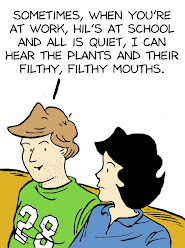
Ted always knew you were watching, reading, listening...all the more so since he stopped taking his Lamictal.

Tuesday, April 29, 2008

Roger Waters Loses His Pig During Coachella Concert. Reward Offered.


From CNN Report: If a 50-foot pig floats by your window, please contact lostpig@coachella.com. The pig can be identified by graffiti on its sides, and the name “Obama” spray-painted on its underbelly.

Thursday, April 24, 2008

I Was a Rock & Roll God, Part Two: The Rise and Fall of a Childhood Friendship over the Course of Seven Full-Length Albums and One Movie Soundtrack


The following, dating from 1979 to 1983 and spanning my entire junior high school experience and half of high school, is the admittedly incomplete discography of my band Coach (there were actually 14 albums in all). Some exacts titles, some “concepts,” even some entire albums, have long been buried both my time and by several hundred tons of garbage somewhere in Long Island. But the story remains as fresh today as the day it started in a suburban basement with an one eight-track tape deck, two childhood friends and at least six fistfights.

“Coach Original” (1979): Our very first album also set the template for every recording to follow—14 songs (12 originals plus one Aerosmith and one Ramones cover)—all played on lead clarinet and Duraflame carton drums—along with album art cribbed from another source (in this case, the package design for Atari 2600’s “Space War”). “Original” also features our one and only hit—“I’m a Fighter”—first penned during the “Lazer” years and obviously influenced by the theme song for “Rocky,” down to a few of the lyrics. I call it a hit because it remains the only Coach song title I can still recall (although as I write this I’m not completely certain if the title is actually “I’m a Fighter,” “He’s a Fighter” or “Let’s Just Fight”).

“Doubleheader” (1979): Released a mere two months after our smash debut, “Doubleheader” followed the “Original” pattern with another 12 original songs, two covers, our signature “clarinet/box drum give-and-take” and album art copied from an Atari package (this time “Video Olympics”). The album not only managed to avoid the sophomore slump by being successfully recorded over a microphone, but also further solidified the Coach sound, best summed up by James’ mother’s response to my constant clanging of the teapot cymbal as “Armageddon meets Chinese New Year.”

“Coach Alive” (1980): The seventies had been a heady time for concert recording aficionados, thanks in part to such major releases as “Frampton Comes Alive!” and “Kiss Alive!” With two full-length albums, 24 original songs and what might have been either an EP or an accidentally-taped practice session, James and I felt the time was right to release the Coach live album, made possible by simply lifting the crowd response from “Cheap Trick at Budokan” (during one song you can actually hear 20,000 screaming Japanese girls chant “Cry! Cry! Cry!”). In addition to being recorded “in front of a live audience” (and featuring cover art practically lifted from Styx’s “Paradise Theater”), “Coach Alive” plays a significant role in our band’s oeuvre for two reasons: 1) I actually sing lead in one song and 2) my voice actually breaks during said song. Yes, thanks to “Coach” I have recorded proof of the very second I hit puberty. Immediately after the song I suggested we take advantage of the moment by “laying down tracks” for a cover version of Peter Brady’s hit, “When It’s Time to Change.” James was never more insulted in his life. It was our first “professional” argument.

“Soundtrack to a Science Fiction Movie Never Made” (1980): Not so much an actual Coach album as a soundtrack to a film James and I had longed to write, direct, star in, edit, produce and market (the album featured only two original Coach songs in addition to ten illegally recorded AOR hits of the day), STASFMNM is a sad reminder of what could have been. Since fifth grade James and I had been working on a full-length sci-fi movie that incorporated characters and plotlines from both our comic strips (which was another way of saying it incorporated elements from “Star Wars” and “Battlestar Galactica”). This being a time before not only digital cameras but also the prevalence of VHS camcorders, James insisted that we do it on 16mm film stock and rent real movie cameras, resulting in an initial budget of $47,000. James said we could easily raise the money. I said much like a depraved squirrel he was fucking nuts. We didn’t speak to each other for almost an entire month. Looking back on it now, it’s somewhat sad that I had opted against wiping out my parents’ life savings to finance the vision of a 13-year-old filmmaker. After all, seeing a rocket ship dock at a spinning space station to the Johann Strauss II’s “On the Beautiful Blue Danube” is one thing. Seeing almost the exact same scene reenacted with cardboard and string to Boston’s “More Than a Feeling,” well, now that’s just art.

“Junk Rock” (1980): Very few musicians can say that they were directly influenced by Sonny Bono. Even fewer can say they were influenced by a Sonny Bono guest-turn on “The Love Boat.” It was during one such appearance that Sonny played an Alice Cooper look-alike called “Deacon Dark,” the leading light of a musical genre the show called “junk rock” and singer of such hits as “Smash It” and “Step, Step, Step on Toads.” Eventually Deacon sees the errors of his hard, head-banging ways and even wins the heart of a deaf girl by switching to soft-rock ballads (she can feel the vibrations when he plays on the piano). But the idea of “junk rock” stuck with me, both because it sounded so damn stupid and because it seemed like just what our band needed to offset the increasing tension of our practices and recording sessions (we were now arguing every half-hour for every hour we played and were often on the verge of a fistfight). Fortunately, James had just recently switched from the clarinet to electric guitar and was quite eager to blow the roof off of Dix Hills, Long Island. By all accounts the album was a raucous (read: “unlistenable”) affair, concluding with our major opus “Crash It,” which clocked in at over 27 minutes and featured the two us of destroying both our instruments as well as part of James’ parents’ basement before spending the final ten minutes beating the living shit out of each other, all of it captured on eight-track glory. And just like Pink Floyd’s “Dark Side of the Moon” ends with the now iconic “heartbeats” from “Eclipse,” Coach’s “Junk Rock” ends on an equally celebrated audio moment—the sound of James’ mom screaming, “Stop it! Stop it!” as James and I banged each other’s skulls against his Ping Pong table.

“The Breaking of the Dawn before the Morning” (1981): Over the next few months James dedicated every waking second to mastering the guitar—taking lessons, learning how to read music, writing more and more songs—everything possible to help him become a real musician. At the same time I was becoming mortified with every single aspect of my life, from the way I looked to the things I did to how I sneezed when alone in my room. Already pathologically shy and having only a few more months before I entered high school as the class pariah, I started doing everything possible to avoid acquiring any further social black marks, from never, ever playing a game of “Dungeons & Dragons” (I have yet to hold a 20-sided die) to never, ever mentioning Coach. Instead, I threw myself into the rather solitary art of cartooning and writing, which after several years would eventually win me a few friends as well as result in me getting very temporarily suspended from school, threatened with a slander lawsuit from a student’s mom, getting my locker searched the two days after the law allowing such was passed and having to spend time with juvenile detention officer Sergeant Jablowski, memorable for both his ridiculous name as well as the fact that he had three nostrils (but all that’s for another tale). Meanwhile James, who had switched to a Catholic school system a few years earlier, was telling every single on of his sacramental school chums about the group, even suggesting that we perform a concert for them, an act that I equated to getting caught masturbating in the gym. When he pressed the issue I clearly pointed out my Duraflame carton bass drum. He then cursed me out for having never invested in a real drum set. I then cursed him out for not knowing when a joke had run its course. We then spent the next two hours threatening to beat each other senseless before recording “The Breaking…,” which James claimed to be our first “serious work” if only because I didn’t write any of the songs or make a single musical suggestion (it was a claim severely tested when James’ mother walk in the middle of our power ballad only to break into uncontrollable laughter).

“Sunday Afternoon” (1982): By now James had started smoking, drinking, driving and growing an actual mustache. I was fat, more or less friendless and almost incapable of speaking in public. Our rehearsals and recording sessions had gone from practically every day tone or twice a week, during which we barely spoke to one other, not out of anger but out of indifference. James had become an excellent guitar player. I couldn’t look at my Duraflame carton without getting ill and spent most of the time drawing while James tuned his guitar between each take. Recorded over eight months—which was eight months longer than we had ever spent recording a Coach album—“Sunday Afternoon” was an all-acoustic album written and sung entirely by James and heavily influenced by Bruce Springsteen’s “Nebraska.” For an album put together by a high school sophomore who had just taken up the guitar just two years prior, it’s by no means a bad collection of songs, marred only slightly by the unfortunately chosen cover of Aerosmith’s “Kings and Queens and Guillotines.”

Album Who’s Title for the Life of Me I Can’t Remember (1983): James and I now traveled in different social circles (if you could describe any group I was in as a “social circle”). We had gone from hanging together almost every afternoon to a couple of days a week to every couple of weeks to eight months down the line when we happened to cross paths. James said he was recording a new Coach album. I came over and played drums on one song, but by this time my presence was completely unnecessary. James was now not only an excellent guitar player but had also taught himself rudimentary multi-track recording, allowing him to play all the instruments as well as provide his own back-up vocals on the very first Coach album committed to cassette…and to my knowledge the last Coach album ever recorded. Having decided long ago to focus my energies on cartooning and writing, I was happy for him. I didn’t really get what he was doing at the time—or why he kept doing it—but I was happy for him all the same.

Sometimes I wonder how things would have turned out had James been a little more realistic and I had been more willing to take a risk. Quite frankly, we would have ended up at the exact same place at the exact same time, all the fights, all the awful recordings, all the now-great memories still intact. On the very rare occasions James and I see each other we laugh about a time in our lives when we had the absolute freedom to try and achieve a dream or just make a complete ass out of ourselves, depending on your point of view.

I never joined another band again. After all, I never really possessed any musical talent. And besides, I’ve been there. I’ve done that. I played the hell out of that Duraflame box.

Wednesday, April 23, 2008

I Was a Rock & Roll God: The All-True Story of a Band Called Coach


Sometimes I wonder how my life would have turned out had MySpace been around when I was a kid. Not simply because my preteen social awkwardness and crippling naiveté would have almost certainly made me the target of sexual predators, but because of how MySpace could have altered the very fortunes of my rock band. A rock band that didn’t feature a single guitar, bass, keyboards or legitimate set of drums. A rock band that had the questionable foresight to record every single one of its albums on eight-track tape. A rock band that—as so many before it—imploded due to infighting, commercial indifference and Catholic school.

Like most of my more memorable experiences from childhood, the band was the brainchild of my good friend James. James had previously been responsible for introducing our neighborhood to “Acorn Wars,” in which each Fall all the kids divided into two warring factions (everybody vs. James and me) and then proceeded to hurl acorns as hard as possible at each other’s head. It soon proved to a popular tradition, lasting ten seasons and both highlighting the very point of “Lord of the Flies” as well as inadvertently causing half my childhood home to burn to the ground, forcing my family to live in a trailer on our own driveway with a pipe leading to the garage toilet for the better part of two years (but that’s for another tale).

James also came up with the idea that we should each own a “pet robot,” a concept that tested both the limits of mid-1970’s technology and eight-year-olds’ wiring capabilities. Those obstacles notwithstanding, James eventually succeeded at his dream by simply inverting a flower-patterned wastebasket on a small pull-cart and topping it off with a wig that clearly said “severed mop.” He then spent the remainder of that summer feeding his robot special “energy pellets” (balled-up pieces of different-colored napkins) so it could help him in his never-ending quests to rid the neighborhood of evil (quests that almost always ended with some parent calling James’ mom and saying, “Uh, yeah, your son is in my backyard running around in a cape and yelling at a pail’). A few months later James sadly put away the robot, citing that its soul was being held captive in a cave by the Viet Cong.

It was also James who-- inspired by the then Sunday night one-two punch that was “Mutual of Omaha's Wild Kingdom” and “The Six Million Dollar Man”—attempted to make the world's first bionic frog, with predictable results. Using a steak knife, the spring from a Bic ballpoint pen and a piece of yarn, James first cut the frog's right hind near the neighborhood pond, instantly severing the muscle. James then unintentionally tore the leg's skin wide open while trying to insert the not-so-coiled spring, resulting in both an exceedingly hyper-extended limb and a less than lucid amphibian. Unable to stitch the leg back up because neither he nor I knew how to sew or remembered to bring a sewing needle, James instead applied copious duct tape to the now "improved" body part, believing it to be both long-lasting and good protection from the rain. I, meanwhile, abstained from the surgical procedure because I had misgivings from the very moment my friend first united the words "frog" and "bionic" and because I come from a long line of less-than-hearty souls (including a little brother who was once deathly afraid of both the vacuum cleaner and the opening credits to “Land of the Lost” and a father who had tripped over a park bench while running away from a butterfly). The patient, alas, was released after only one installed bionic feature. He then proceeded to jump at angles often at 90 degrees variance from his intended direction, until he eventually made his way back to the pond...from which he never resurfaced.

***********************************************************

By the end of our elementary school years, James—having exhausted all that nature and technology had to offer—came upon another idea. An idea that spoke directly to anyone about to face the visceral thrills and absolute horrors of junior high school. An idea that could be summed up in five short words—“Let’s start a rock band.”

Now, truth be told, this was not the first time we had tried to start and maintain a band. Back in 1976, James, our friend Bruce and I formed the jazz combo “The Winston Woodchucks” (named after our development, “Winston Woods”). The trio—perhaps the only one to feature two clarinets and a tuba—played such standards as “Mary Had a Little Lamb” and the chorus to “Convoy” as well as our very first original songs, all of which were inspired and defined by the very limitations of our band. Our first single—“The Car”—brilliantly captured the driving, horn-honking sound of heavy rush-hour traffic. Our next single—“The Train”—beautifully portrayed the propulsive horn-tooting of a 20th Century Limited. By the time I showed up to practice with the sheet music for our third single—“The Boat”—we had all become painfully aware of the musical trap we had set for ourselves.

But out of the ashes of “The Winston Woodchucks” rose the Phoenix-like “Lazers” (spelled with a “z” instead of an “s” so as not to be confused with the real thing), an entirely new instrumental band featuring a tuba and only one clarinet (I had given up the instrument a few months earlier). The “Lazers” lasted less than a month but it was during that time James happened upon an idea that would shape our very lives…or at least the next few years.

“What we need,” he said with complete authority, “is a drummer.”

And so in the summer of 1979 James and I embarked on forming our two-man supergroup (featuring the major forces behind “Winston Woodchucks” and “Lazers”). James would handle lead vocals, lead clarinet and press the “record” button on his eight-track tape deck. I would sing backing vocals and play the drums, the latter hampered by just two little facts: 1) I had never played the drums before and 2) we had no drums. But for a kid like James—who had once tried to make his own one-man helicopter with a plank of wood and two fish tank air compressors—these facts were minor inconveniences at best. He quickly fashioned a complete kit, using a Duraflame carton for my main drum, a “Gunsmoke” lunchbox for my snare and a Chinese teapot filled with screws for my cymbals. After a few practice sessions—during which I eventually proved my proficiency at holding two drumsticks concurrently and no longer making guitar sounds with my mouth—we were ready to grab our seats at the rock & roll banquet table.

All we needed was a name. After much deliberation we settled on two choices—“Coach” and “Joe Booger and the Eight Nose-Pickers.” Further discussion led us to opt for “Coach,” if only because it sounded serious—and if there’s one thing a 12-year-old boy wants when hammering down on a Duraflame carton after a blistering clarinet solo in a cover version of “Toys in the Attic,” it’s to be taken seriously.

And so having decided upon a name, having proven our musical chops to ourselves and having purchased several blank eight-track tapes for recording, Coach set up shop in James’ parents’ basement, under the watchful eye of his younger sister’s Shawn Cassidy poster. It’s there that we spent almost all of our free time over the next four years, trying to set the world on fire one song at a time…

Next Time, Part Two: “The Rise and Fall of a Childhood Friendship over the Course of Seven Full-Length Albums and One Movie Soundtrack”

After All, Remember What a New Hairdo Did for "Felicity"...

Before:


After:


Craig and I read your emails. We received the complaints. We heard your question, posed over many years, loud and clear: "Why can't Hilary lose the pigtails?"

And now she has. For good.

She may have also gotten a tattoo, but that isn't as evident.

Now we can all go back to questioning Ted's machismo.

Oh, and if you did send the artist an email asking him to change Hil's hairstyle, send him another one thanking Mr. MacIntosh for listening. He'd appreciate that.

Thursday, April 17, 2008

Beloved 70'S Television Episodes

* Mr. Roarke somehow manages to turn even a small child's fantasy about an emergency liver transplant into a hard lesson on the perils of getting what you wish for.

* The fine line between "comically delinquent" and "criminally dangerous" is forever blurred when the Sweathogs adopt a gang color.

* Hawkeye's constant switching from Marx Brothers-inspired silliness to sermons on the horrors of war reaches its zenith when he treats a soldier who has lost his legs but somehow wound up with a duck on his head.

* Battlestar Galactica emphasizes its Egyptian mythology parallels with an awkward cameo from Anwar Sadat.

* Already in trouble for trying to bootleg a Doobie Brothers concert, Rerun is forced by bullies to illegally record a KC & The Sunshine Band show while Raj and Dwayne are left to wonder why only the whitest bands in America come to play South Central.

* Jack Tripper must once again prove to Mr. Roper that he's gay, this time by sleeping with another man while his landlord watches through a peephole in the next room, pantsless.

* The Bionic Man, Bionic Woman and Bionic Dog match wits with Bigfoot in an episode selected from an elementary school writing contest.

* Harvey Korman can't stop laughing when a peach pit gets lodged inside Tim Conway's throat.

* Fearing the public would soon tire of "Whatchoo talkin' bout?" Diff'rent Strokes writers introduce Arnold Drummond's new catchphrase--"Bitch, I said pancakes!"

* In a famous Happy Days/Laverne & Shirley crossover story, Arthur Fonzarelli and The Big Ragu fill Italian-American viewers with both great pride and terrible shame.

* When an outbreak of Legionnaire's Disease occurs on the Pacific Princess, Captain Stubing learns just how little an ocean liner-appointed doctor is equipped to handle.

* The simple American pioneer life continues on Little House on the Prairie as each family must blind their eldest daughter to appease the harvest god.

* In a story ripped from the headlines, killer bees kidnap Nancy Drew and brainwash her into joining their terrorist group while the Hardy Boys try to prevent an OPEC oil crisis only for their DC-10 to nosedive.

* Although forbidden to do so, Carol ascends the stairs to the attic only to find the first Mrs. Brady still alive and quite mad.

* The electricity is shut off, someone is shot, the city is on fire, rabid wolves patrol the tenement halls and everyone loses their job in just another typical episode of the ironically-titled Good Times.